The Signal Is Rare
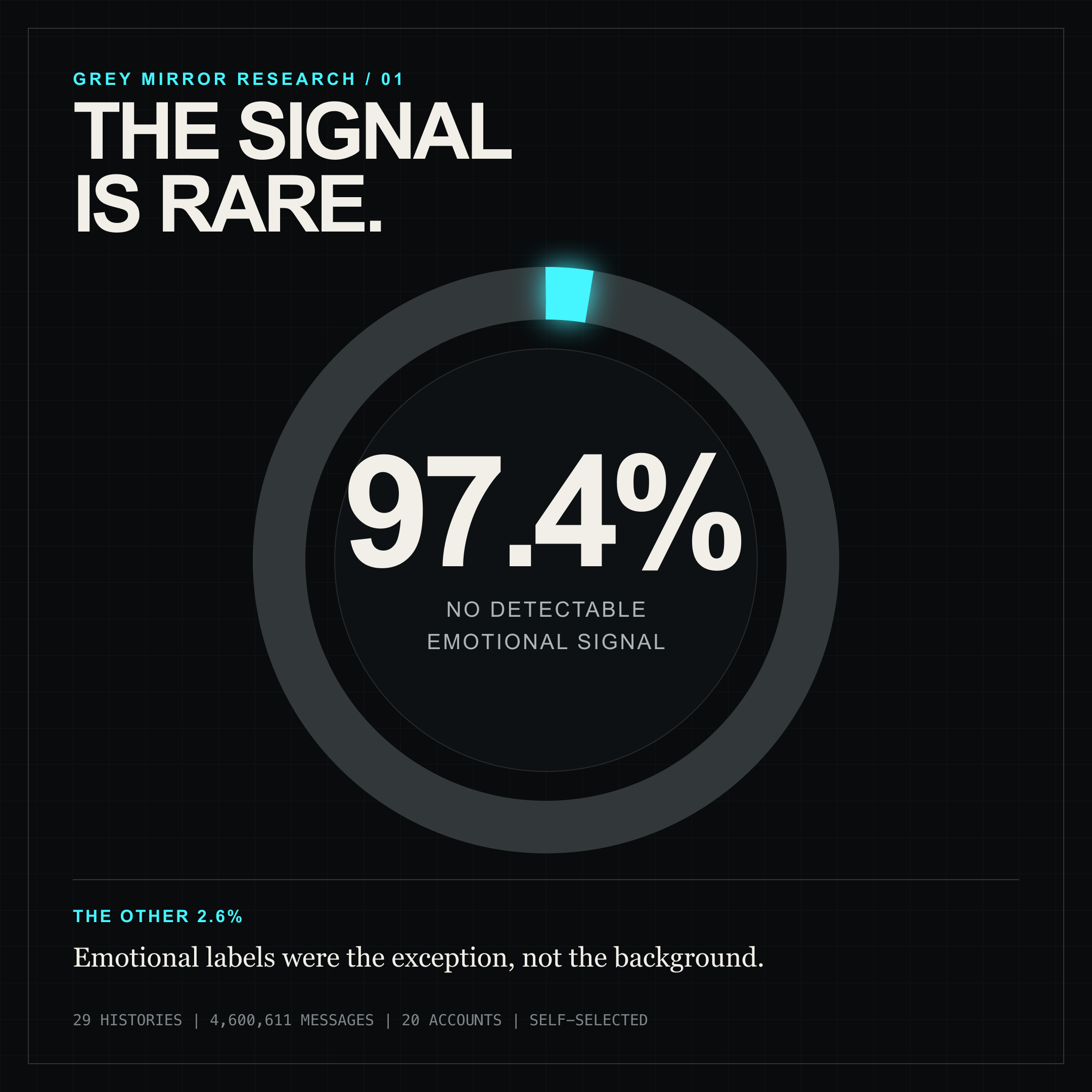
Conflict outran repair. 97.4% of texts carried no detectable emotional signal. And one reply-time claim was withheld because the data did not support it.
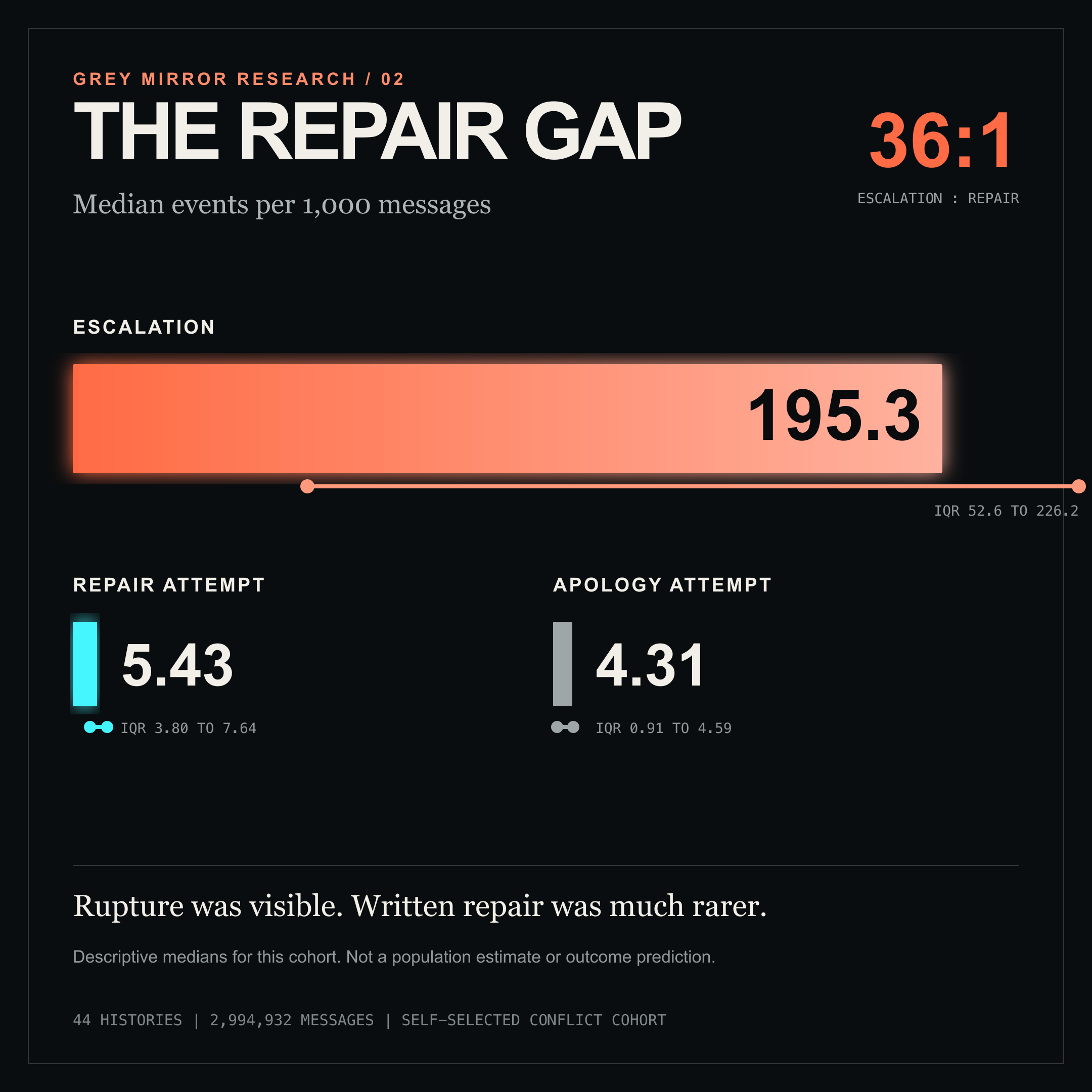
The Signal Is Rare is Grey Mirror research across two separate observed cohorts of complete relationship-message histories and one synthetic benchmark. In the 29-history signal cohort of 4,600,611 messages from 20 accounts, 97.4% of messages carried no detectable emotional signal and affection outnumbered explicit repair attempts by about 10.7 to 1. In the 44-history conflict cohort of 2,994,932 messages, median escalation ran 195.3 events per 1,000 messages against 5.43 repair attempts, roughly a 36 to 1 gap, and only 5 of 44 histories repaired more often than they escalated. The two cohorts were built for different measures, may overlap, and are never summed.
The provenance is published rather than summarised. The analytics rollup held 347 conversations, 20,794,571 messages and 88 accounts, which is an operational universe and not a research cohort. 126 conversations met eligibility at 500 or more messages across at least 30 days, and 29 de-duplicated histories were published. The storage manifest held 661 file records but only 470 unique content hashes; the 191 repeats were treated as duplicate file records rather than as more evidence. Two operational datasets were excluded from findings entirely: the run summary and the reply-latency rollup.
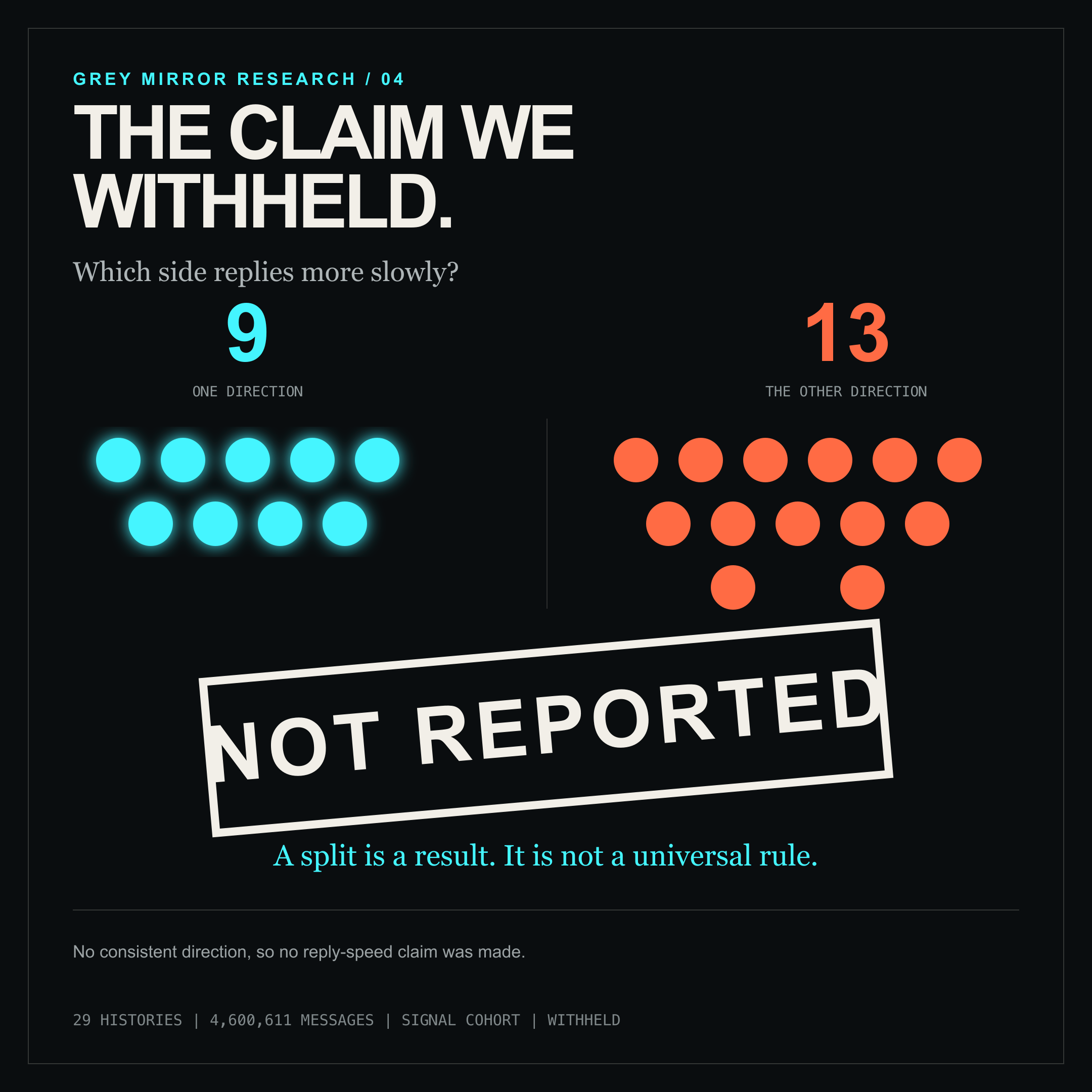
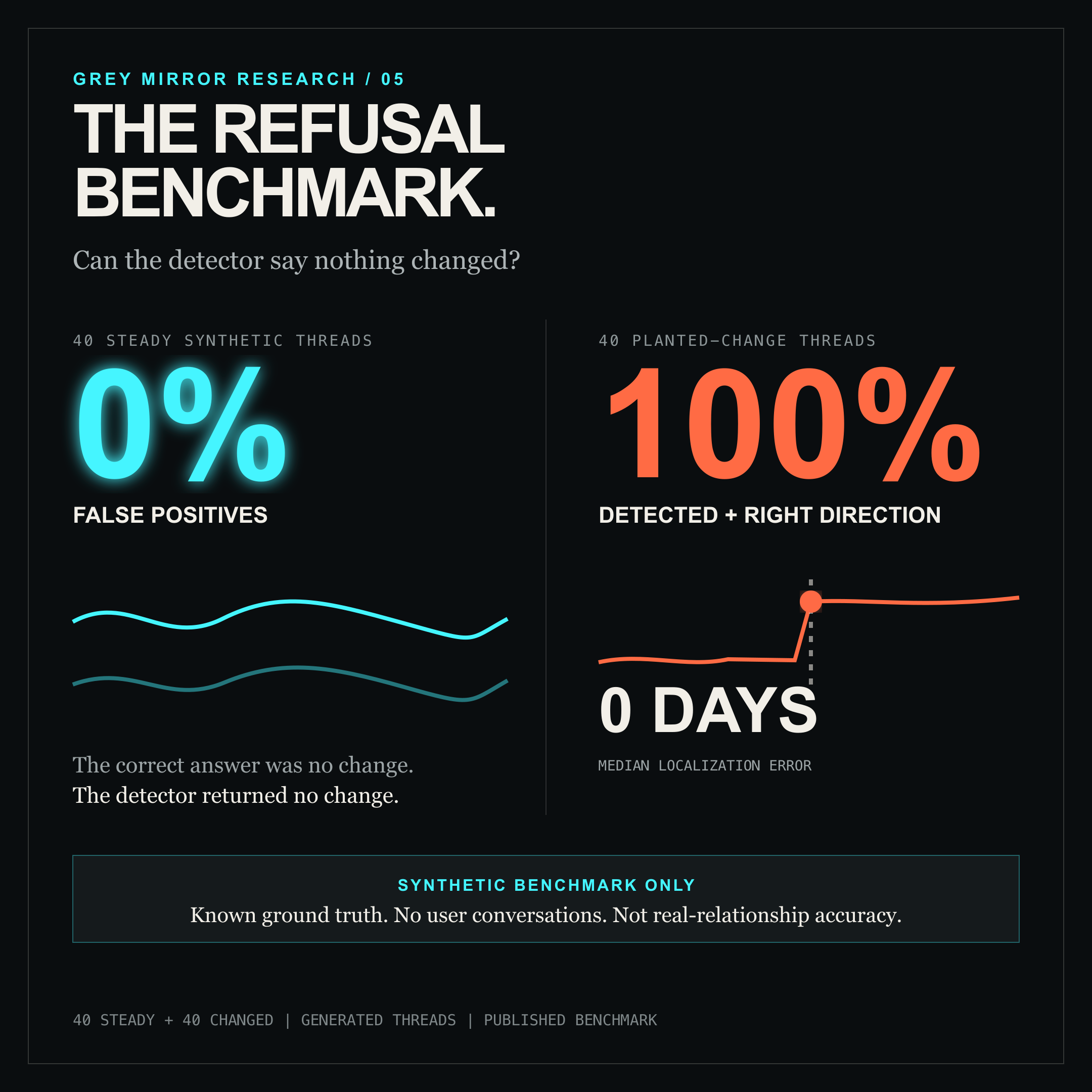
One measure was deliberately withheld: threads split 9 to 13 on which side replied more slowly, so no reply-speed claim was made. A synthetic turning-point benchmark produced zero false positives across 40 steady threads and detected all 40 planted changes with correct direction and median zero-day localisation error. An evidence-retrieval benchmark on one full-fidelity 163,636-message artifact reported mean recall of 87.9% at k=5 and 100% at k=32, at 328.6 messages per second. That figure measures evidence retrieval only; it is not classifier accuracy and not real-relationship validity.
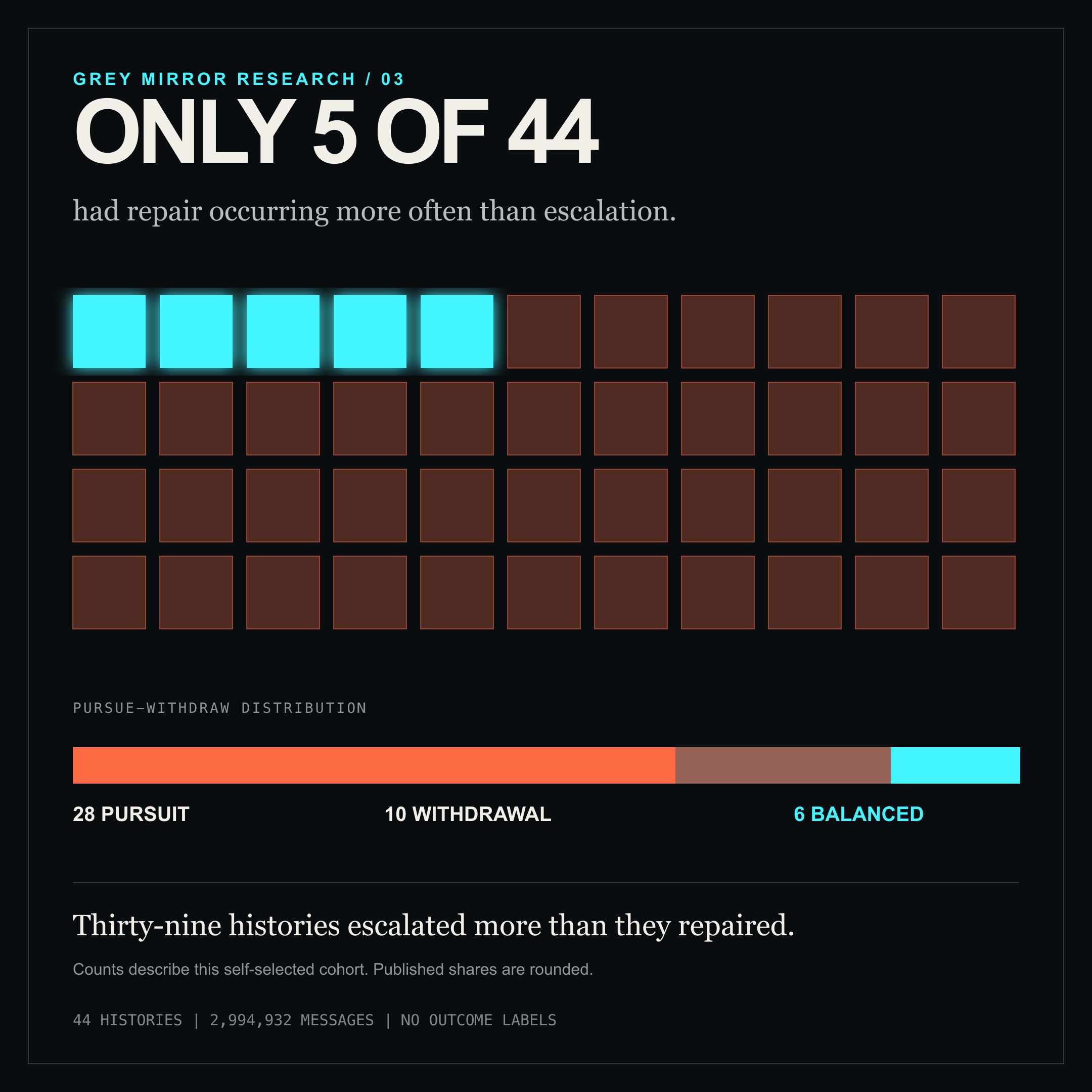
The conflict cohort splits by shape, not only by rate. Of the 44 histories, 28 were pursuit-skewed, 10 were withdrawal-skewed, and 6 were balanced. That is the pursue-withdraw pattern appearing in roughly two thirds of observed histories, measured from message behaviour rather than from self-report: pursuit-skewed means one side repeatedly re-opened a conflict the other side had stopped answering. Only 5 of the 44 repaired more often than they escalated. These proportions describe the conflict cohort alone and are not generalisable to relationships at large, because the histories were uploaded by people who already had a reason to ask.
Explicit apology is rarer than repair of any kind. Across the conflict cohort the apology-attempt rate ran 4.31 per 1,000 messages against a repair-attempt rate of 5.43 and an escalation rate of 195.3. Repair, in other words, more often takes the form of a subject change, a joke, or a return to routine contact than of a stated apology. Because escalation outruns every repair signal by roughly 36 to 1, the scarcity of repair is the finding, not the presence of conflict.
Scale is what separates this from screenshot research. The conflict cohort covered 2,994,932 messages across 44 complete histories, with a median thread length of 1,570 messages and a largest thread of 163,636. In the 29-history signal cohort the person who uploaded the conversation accounted for 53% of the messages in it, close enough to even that upload bias does not explain the signal findings on its own. Every figure on this page is attributed to the cohort it came from; the cohorts were built for different measures, may overlap, and are never summed.
Data, methodology and charts
Every figure on this page is reproducible from the files below. They are published under the same open terms as the study itself.
- Full findings dataset (JSON) -- all 17 measures with cohort attribution
- Master findings (CSV)
- Data dictionary (CSV) -- what every field means
- Provenance audit (CSV) -- the 347 to 126 to 29 eligibility funnel
- Signal cohort counts (CSV) -- 29 histories, 4,600,611 messages
- Conflict and repair rates (CSV) -- 44 histories
- Pursue-withdraw distribution (CSV) -- 28 / 10 / 6
- Withheld measures (CSV) -- what the data did not support
- Turning-point benchmark (CSV)
- Evidence-retrieval benchmark (CSV)
- Methodology in full
- Sources
- Press notes and citation guidance
- Chart 1: 97.4% carried no detectable signal (PNG, 2160x2160)
- Chart 2: the repair gap, 36 to 1 (PNG, 2160x2160)
- Chart 3: only 5 of 44 repaired more than they escalated (PNG, 2160x2160)
- Chart 4: the claim we withheld (PNG, 2160x2160)
- Chart 5: the refusal benchmark (PNG, 2160x2160)
Start here
- Analyze your messages — upload a full exported history on the web and watch the first scenes free.
- Grey Mirror for iPhone — the free native iOS app, App Store id 6799236359, iOS 18 or later. Same exports, same report as the web.
- Pricing — the complete report is a one-time $25 unlock, no subscription.
- Published research — aggregate benchmarks across 4,600,611 messages, with the withheld measures stated.